
How to choose a speech biomarker provider for a CNS clinical trial
A checklist from Cephalgo, a speech biomarker company in Strasbourg, France. Ask any speech biomarker provider ten questions before your trial: which scale the reading lands on, where the audio comes from, what happens when phones change, what sits behind each reading, and how the data and evidence hold up to review.
Checklist for trial sponsors, clinical operations and digital endpoint teams · Updated November 2026
What the reading measures
A speech reading has to fit the trial’s analysis plan. These questions test whether it can.

-
Which clinical scale does the reading land on?
A reading on a scale the trial already uses can be joined to each visit score and read in units reviewers know. A new score with no link to the trial’s scale is harder to place in a statistical analysis plan.
How Cephalgo handles itCephalgo reads speech on, or beside, the scale the study already uses, such as MMSE or MoCA, MDS‑UPDRS item 2.1, Stroop Word Reading in the cUHDRS and the ALSFRS‑R speech item, calibrated on the study’s screening and baseline ratings, blind to arm.
-
Which named features sit behind each reading?
Reviewers and statisticians need to know what a reading responds to. Named features let a team check a result and set it beside its own measures.
How Cephalgo handles itEvery Cephalgo reading comes with the named voice and language features behind it, and each analysis stream is reported on its own.
-
Which evidence framework does the validation follow?
The DiMe V3 framework splits evidence into verification, analytical validation and clinical validation. The FDA’s digital health technology guidance asks that a technology be fit for purpose in its context of use.
How Cephalgo handles itCephalgo evaluates each reading stage by stage following the DiMe V3 framework, one indication at a time, and your study’s validation report follows TRIPOD+AI. Validation approach ›
Where the audio comes from
Speech can come from recordings a trial already holds, from site visits and from home sessions. Each source raises its own questions.
-
Can it re‑analyse recordings the trial already holds?
Many trials already record rating interviews and speech tasks, and most of that audio is never analysed. Reading it needs no new collection and can inform the next protocol.
How Cephalgo handles itCephalgo runs a re‑analysis pilot on audio from completed or ongoing trials, where consent covers further analysis, with readings on the trial’s scale joined to the visit scores. Re‑analysis pilot ›
-
Does it read site‑visit recordings and home sessions?
Site visits give a reading beside each rated visit. Home sessions add readings between visits, so a change can be seen before the next scheduled visit.
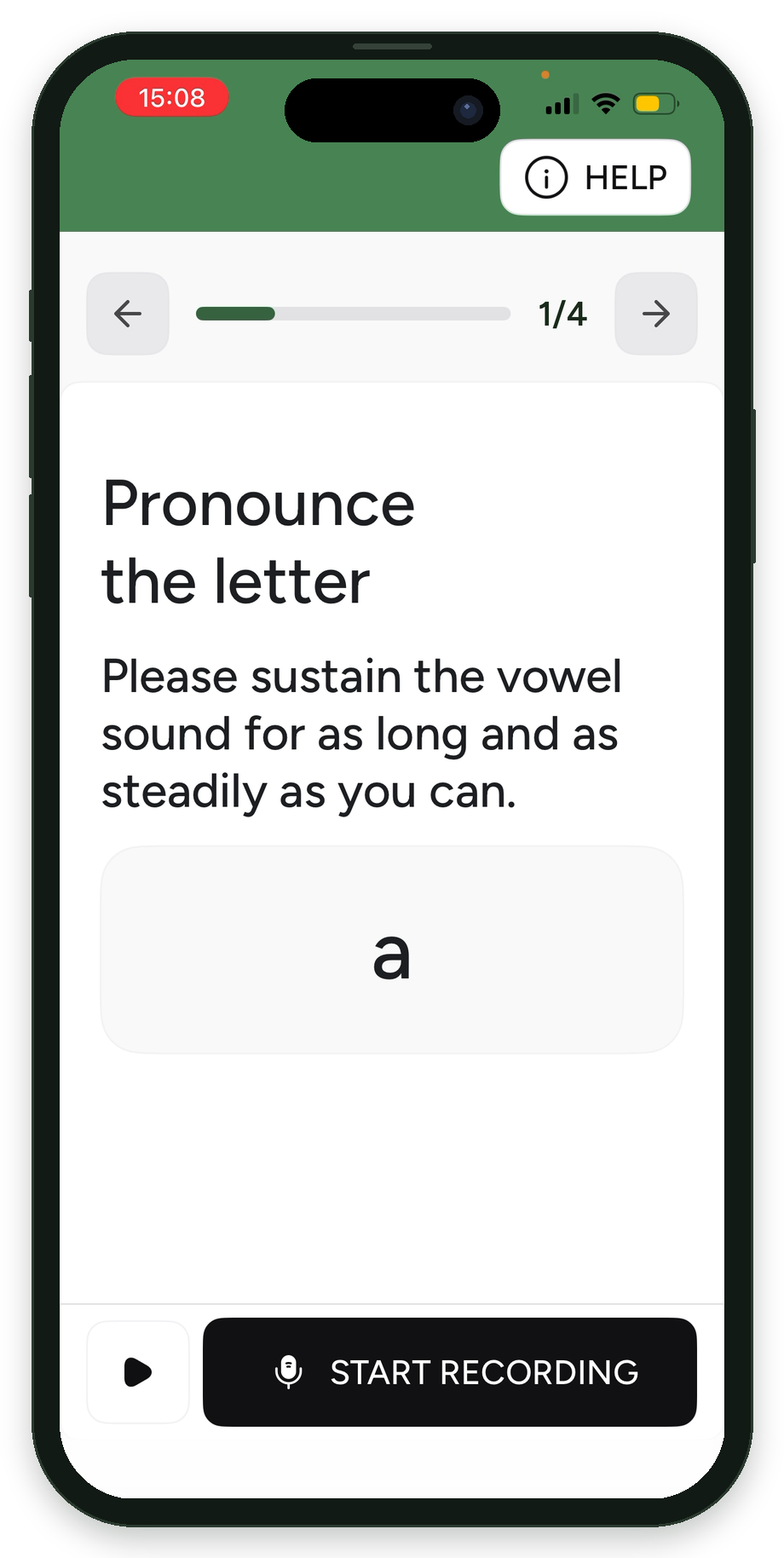
How Cephalgo handles itCephalgo reads three sources: recordings a trial already holds, recordings sites already make at visits, and short home sessions.
-
What happens when phones or their software change mid‑study?
Operating system and app updates, noise cancellation and new phones change the audio before analysis, so a phone change can read as disease change. The FDA’s December 2023 guidance asks sponsors to record updates and compare data before and after when an update may change the measurement.
How Cephalgo handles itCephalgo readings stay stable across phone and software changes, recalibrated from the audio blind to arm, and every reading carries its analysis version, with device, operating system and app version where the recording app provides them, otherwise the processing period read from the audio. Phone changes and speech endpoints ›
-
Does it run inside your eCOA or app vendor’s system?
A separate app adds burden for participants and one more system to validate. Speech tasks inside the existing eCOA keep one schedule and one data flow.
How Cephalgo handles itCephalgo’s speech tasks run inside your eCOA as one more task, with readings returned to the same system. A phone call, a browser or Cephalgo’s app are used where a study has no eCOA. Capture platform ›
-
Which languages, and how is each one calibrated?
Multinational trials rate the same scale in many languages. Speech differs by language, so tasks, quality rules and calibration need to hold in each one.
How Cephalgo handles itCephalgo runs the same tasks and the same quality rules in each study language and calibrates readings on the study’s own screening and baseline ratings. For pre‑screening, the entry range is calibrated per study language.
How it fits trial operations and qualification
The same recordings can show how each rating interview was given. Your QA team will also need to qualify the provider.

-
Can it review recorded rating interviews?
Baseline inflation, rater drift and off‑protocol administration add noise that can look like placebo response. A recorded interview shows how each scale was given and scored.
How Cephalgo handles itCephalgo Trial QC checks each recorded rating interview against the rater’s own usual range, and its item scores against what was said, with flags per rater, site and interview for your blinded team or central rating vendor. Rating interview quality control ›
-
How is the data protected, and where is it hosted?
Speech recorded to measure health is health data, a special category under GDPR. Your QA team will ask for audited security controls, data protection documents and records that support inspection.
How Cephalgo handles itCephalgo provides a SOC 2 Type II report, a DPIA, records of processing and an Article 28 data processing agreement, processes data in the EU or US under pseudonymized IDs, and keeps records designed to support 21 CFR Part 11 and EU Annex 11. Vendor qualification ›
Sources to read before you choose
These documents set the terms most sponsors, reviewers and providers use for speech measures in trials.
U.S. Food and Drug Administration. Digital Health Technologies for Remote Data Acquisition in Clinical Investigations. Final guidance, December 2023.
Covers fitness for purpose, verification and validation, and how sponsors should record and handle updates to the technology and to the phones it runs on.
Goldsack JC, et al. Verification, analytical validation, and clinical validation (V3): the foundation of determining fit‑for‑purpose for Biometric Monitoring Technologies (BioMeTs). npj Digital Medicine. 2020. doi:10.1038/s41746-020-0260-4
The DiMe V3 framework: three stages of evidence a digital measure has to clear.
Consensus‑Based Definitions for Vocal Biomarkers: The International VOCAL Initiative. Digital Biomarkers. 2026. doi:10.1159/000553327
An international consensus that distinguishes vocal features from vocal biomarkers, which need validation for a defined context of use.
International Society for CNS Clinical Trials and Methodology (ISCTM)
A forum for CNS trial methods. Cephalgo presented a poster on speech endpoints and phone changes at the ISCTM 2026 Autumn Conference.
Choosing a speech biomarker provider

How do I choose a speech biomarker provider for a CNS clinical trial?
Ask which clinical scale the reading lands on, whether it can read recordings the trial already holds, site‑visit and home recordings, what happens when phones or their software change, which named features sit behind each reading, whether recorded rating interviews can be reviewed, how each language is handled, how it fits your eCOA, how data is protected, and which evidence framework the validation follows.
What is a speech biomarker?
A speech biomarker is a measure taken from speech that has been shown to relate to a clinical state for a defined context of use. The VOCAL consensus, published in Digital Biomarkers, distinguishes vocal features from vocal biomarkers, which need validation for a defined context of use.
Can a speech biomarker be added to a trial that has already finished?
Yes, if the trial recorded speech or rating interviews and consent covers further analysis. Cephalgo reads such recordings in a re‑analysis pilot, with readings on the trial’s own scale joined to the visit scores and no new collection.
What should a sponsor ask a speech biomarker provider about phone changes?
Ask how readings behave when operating system or app updates, noise cancellation or a new phone change the audio, and whether every version change is recorded. The FDA’s December 2023 DHT guidance asks sponsors to record updates and compare data before and after when an update may change the measurement.
What does vendor qualification for a speech biomarker provider involve?
Your QA team typically asks for a SOC 2 Type II report, an audit against its own checklist, GDPR documents such as a DPIA and a data processing agreement, electronic records that support 21 CFR Part 11 and EU Annex 11, and legal entity details. Cephalgo shares these documents during vendor qualification and onboarding.
Which CNS programs does Cephalgo work in?
Cephalgo provides speech biomarkers for Alzheimer’s, Parkinson’s, Huntington’s and ALS trials, as well as DM1 and neuromuscular programs and psychiatry, each read on or beside the scale the trial already uses.