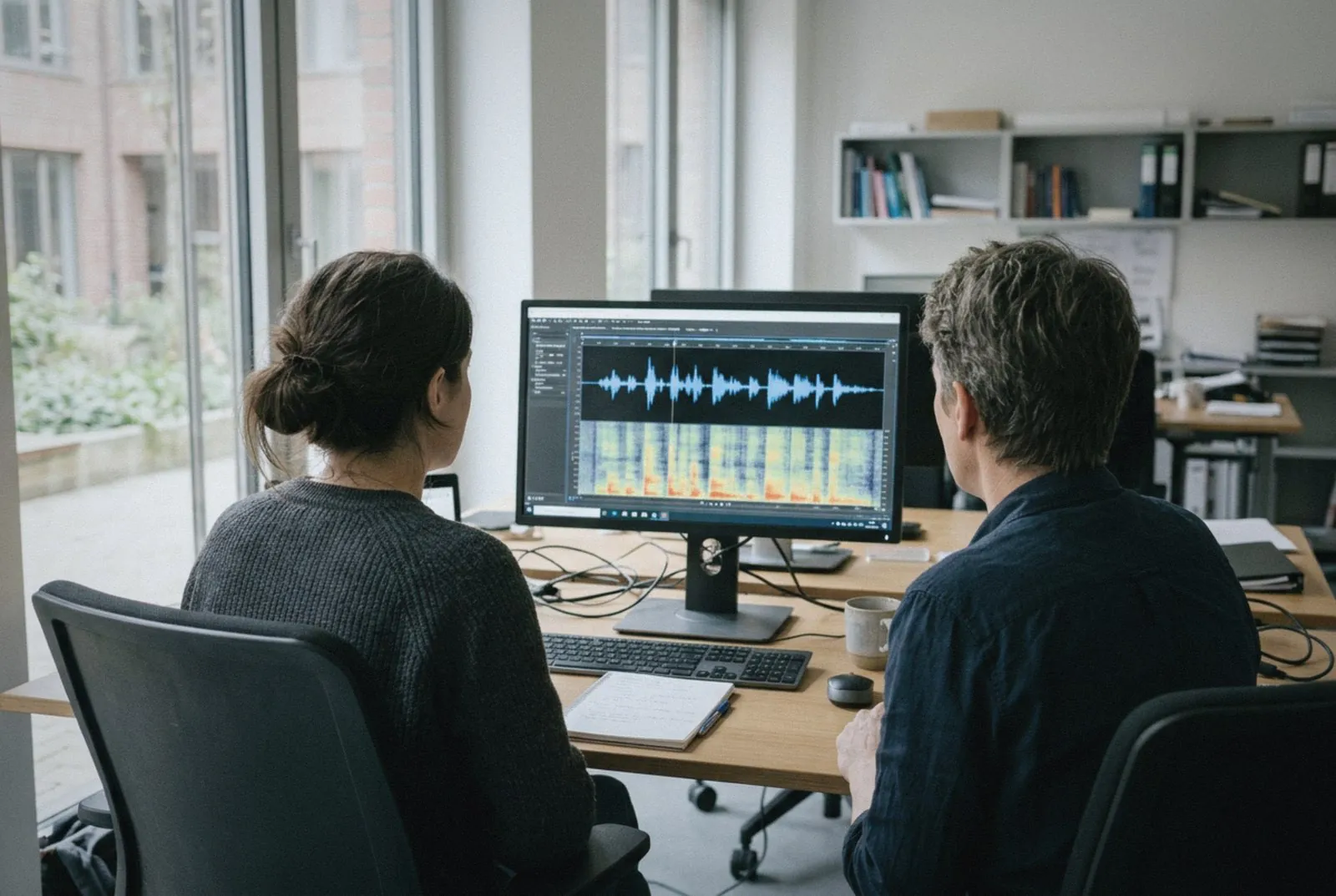
Do phone and software changes shift speech endpoints in clinical trials?
Yes, they can. Noise cancellation, operating system and app updates, and new phones change the audio before analysis, so speech measures can move while the participant has not changed.
Explainer for trial sponsors and digital endpoint scientists · Updated November 2026
Four ways the recording chain changes during a trial
Between the participant’s voice and the audio file sit a microphone, the phone’s own processing, the capture app and often a compression step. Each can change while a study is running.
Noise cancellation
Phones clean up speech with built‑in noise suppression, echo control and level adjustment. The method differs by phone and by app, and it can change with an update.
Operating system and app updates
An update to the phone’s operating system, the capture app or its audio codec can change how the audio is filtered or compressed. The study is rarely told.
Phone replacement
Participants lose, break or upgrade their phones. A new model brings a different microphone and different processing, from one visit to the next.
Bring your own device or study phones
With participants’ own phones, every person has a different chain and updates arrive on their own schedule. Study phones narrow the spread, but they still receive updates.
A measure can move while the participant has not
Speech endpoints are read as change over time. If the audio processing changes partway through, part of the measured change comes from the phone, not the person.
Change with no clinical cause
Pitch variation, voice quality, pauses and spectral measures respond to filtering and compression. A shift can look like decline, or like a treatment effect.
Long trials carry more risk
Alzheimer’s and Parkinson’s trials often follow participants for a year or more. Over that time, most phones receive several software updates.
It may not cancel out
Updates do not arrive evenly across sites, countries or arms. A shift can add variance, or bias, to the comparison a trial is built on.
Hard to see afterwards
Nothing in the speech data flags a processing change. Without a record of versions, a sponsor cannot tell when it happened or which recordings it touched.
The FDA asks sponsors to plan for updates
The FDA’s final guidance Digital Health Technologies for Remote Data Acquisition in Clinical Investigations (December 2023) covers updates to the technology and to phones and other general‑purpose computing platforms, whether sponsor‑provided or bring your own.
Record
Keep a record of the timing and nature of every update for each digital health technology used in the trial.
Assess
Make sure the technology stays fit for purpose after an update. Where measurements may be affected, validate them again, for example with data already collected.
Compare
If a measurement changed after an update, compare data from before and after, and run sensitivity analyses where needed.
Plan before unblinding
Say how the differences will be handled in the analysis before unblinding, and describe their possible impact on trial outcomes.
“Sponsors should keep a record of the timing and nature of any updates for each DHT.” If the measurement changed, “sponsors should compare data from DHTs before and after the update” and “specify how these differences will be addressed in the analysis of the trial prior to unblinding.”
Run the same recordings through different processing
The cleanest test holds the speaker fixed and changes only the processing. It fits into analytical validation and can run on recordings a sponsor already holds.
Start from real recordings
Use recordings from the target population, ideally patients and controls, captured at the highest quality available.
Process them several ways
Apply conditions that mirror real phone changes: different noise‑cancellation methods, compression formats and bit rates, and level control.
Compare within each recording
Extract every speech measure under each condition. The speaker is identical, so any difference comes from processing.
Report agreement per measure
Give agreement and bias per measure, and check whether the difference between patients and controls still holds in every condition.
Check before unblinding
Repeat the test when a new phone model, operating system or app version enters the study, and finish it before the data are unblinded.
Document versions
Log device model, operating system build, capture app version and analysis version with every recording, so each one can be placed in time.
A checklist for sponsors
Questions to settle before the first participant records, whoever supplies the phone or the analysis.
- Device model, operating system build, app version and analysis version are logged with every recording.
- Audio is stored uncompressed or lossless, so a codec update cannot change it after capture.
- You know which noise cancellation is active in the capture app, and whether an update can change it.
- The choice between participants’ own phones and study phones takes this risk into account.
- On study phones, update timing is controlled where security allows, and every update is recorded.
- Speech measures were tested for stability under processing changes during analytical validation.
- The statistical analysis plan says how version changes will be handled, written before unblinding.
- Your speech analysis provider can show how its measures behave when phones or their software change.
Who has studied this
Voice and speech science has measured the effect of devices, rooms and file formats on acoustic measures for years. Recent conference work looks at phone processing inside clinical trials.
Published studies
Jannetts S, Schaeffler F, Beck J, Cowen S. Assessing voice health using smartphones: bias and random error of acoustic voice parameters captured by different smartphone types. International Journal of Language & Communication Disorders. 2019;54(2):292–305. doi:10.1111/1460-6984.12457
Recorded the same speakers on a studio microphone and several smartphones. Some voice measures showed a systematic bias across devices, and jitter and shimmer were judged unreliable.
Bottalico P, et al. Reproducibility of voice parameters: the effect of room acoustics and microphones. Journal of Voice. 2020;34(3):320–334. doi:10.1016/j.jvoice.2018.10.016
Played the same recordings back in different rooms through six microphones. Room acoustics and background noise moved voice parameters more than the type of microphone.
Awan SN, et al. Validity of acoustic measures obtained using various recording methods including smartphones with and without headset microphones. Journal of Speech, Language, and Hearing Research. 2024;67(6):1712–1730. doi:10.1044/2024_JSLHR-23-00759
Compared microphones, audio interfaces and two smartphones against a research‑grade reference. Device, setting and distance had significant, predictable effects on acoustic measures.
Oreskovic J, Kaufman J, Fossat Y. Impact of audio data compression on feature extraction for vocal biomarker detection: validation study. JMIR Biomedical Engineering. 2024;9:e56246. doi:10.2196/56246
Converted the same voice recordings to common compressed formats with different tools. The effect on extracted features depended on the format, the tool and the feature.
Cephalgo posters
Parkinson’s and control recordings run through different noise‑cancellation methods: standard speech measures moved, while a multi‑stream reading stayed stable.
Readings that stay stable when phones change
Cephalgo’s speech biomarker readings stay stable across phone and software changes. Each reading is recalibrated from the audio itself, on any phone or capture app, blind to treatment arm, with the recordings left untouched.
Device changesPhone changes and speech endpoints
Can a phone update change speech-based endpoints in Alzheimer’s or Parkinson’s trials?
Yes. Operating system, app and noise-cancellation updates change the audio before analysis, so speech measures can shift while the participant’s speech has not changed.
What does the FDA say about updates to digital health technologies in trials?
Its December 2023 guidance asks sponsors to record the timing and nature of updates, compare data before and after, and say how differences are handled before unblinding.
How do you test whether a speech measure is stable across phone changes?
Process the same recordings under different noise-cancellation and compression settings, then compare each measure within each recording. The speaker is identical, so any difference comes from processing.
Who has studied how recording devices affect speech and voice measures?
Published studies include Jannetts et al. 2019 and Awan et al. 2024 on smartphones, Bottalico et al. 2020 on rooms and microphones, and Oreskovic et al. 2024 on audio compression.
Are study-provided phones safer than bring-your-own-device for speech endpoints?
They reduce variation between participants, but study phones still receive operating system and app updates, so versions still need logging and stability testing.