
Another layer of sensitivity and specificity, from phones and audio you already have
Speech from recordings your trials already hold, site-visit recordings, or participants’ own phones through your eCOA vendor, read on your scale. Each reading is recalibrated from the audio when a phone or its software changes.
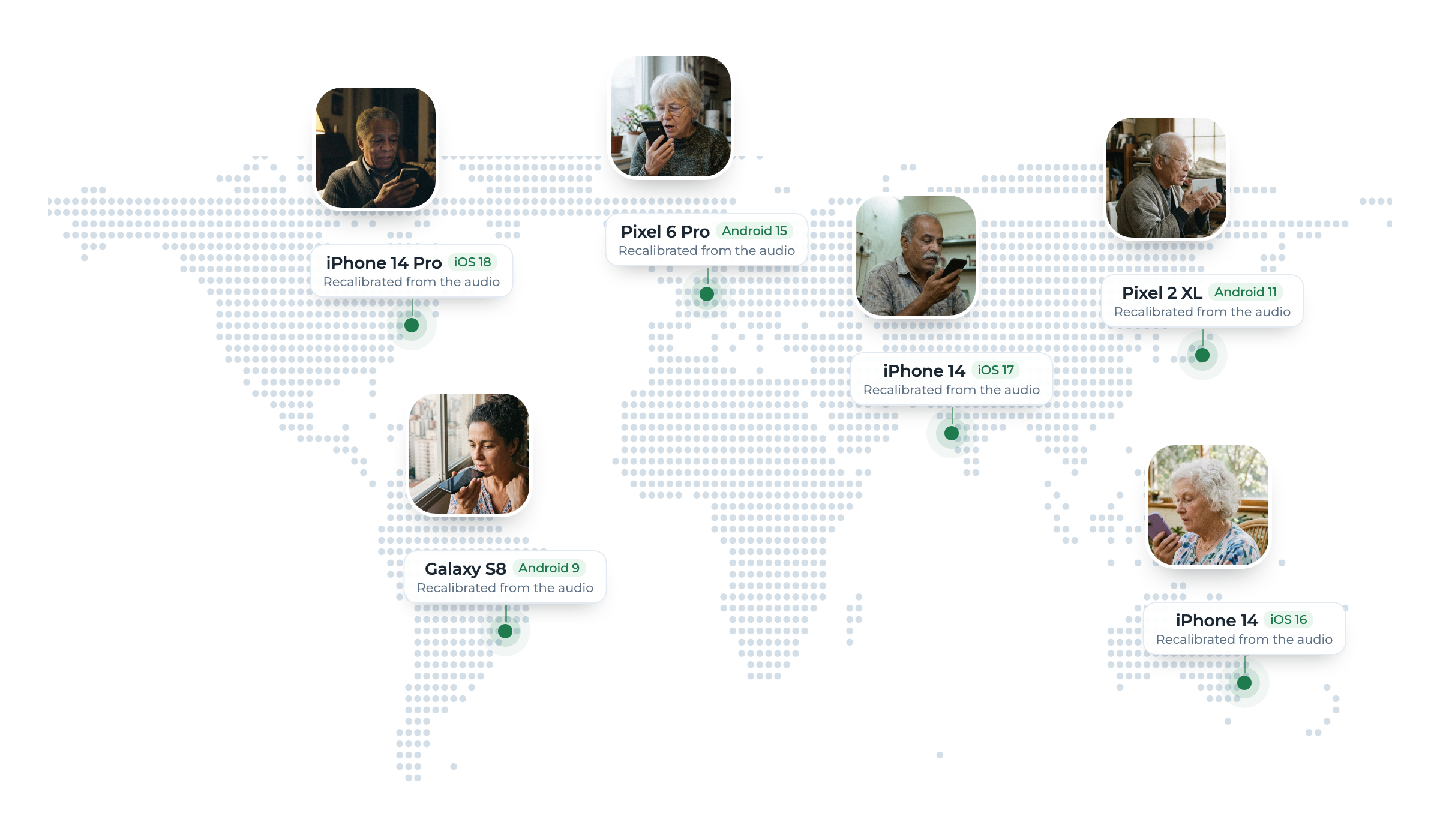
No devices to buy, no new collection
Audio you already hold, or recorded on participants’ own phones, gives more readings on the scale the trial already runs. Recalibration keeps readings stable across phone changes.
Recordings you already hold
Audio from a completed or ongoing study, recorded on any phone or app, read and recalibrated the same way.
Whatever app records
Your eCOA, an app vendor’s, or ours where the study has none; the reading comes from the audio.
No device logistics
No study phone to stock, track or replace, and no extra site visit.
Multilingual
The same tasks and the same quality rules in each study language.
Recalibrated from the recordings themselves
The method runs from the audio alone, whatever the phone or capture app, including another vendor’s, so readings stay stable across a phone change or update.
Processing periods from the audio
A processing period is a stretch of time with one processing setting on a phone. Each recording is placed in its period from the trace processing leaves in the audio.
One shift per period
The speech features most stable across processing settings are used to estimate one shift per measure for each processing period.
Your analysis, unchanged
Our model and the study’s measure definitions stay fixed; your longitudinal analysis runs as planned, and your own measures can be recalibrated the same way.
Audio untouched, blind to arm
Recalibration acts on the measures alone, leaves each recording as captured and runs blind to treatment arm.
What phones do to speech
We read the capture configuration and calibration files in the stock firmware, recording mode by recording mode.
Dynamic range compression is common
A compressor or limiter runs on the voice-recognition path of many Android phones, and in the default recording mode of every iPhone model we read.
Same series, different processing
The Snapdragon Galaxy S24 Ultra runs a compressor on its voice-recognition path; the Exynos Galaxy S24 does not.
Updates change the chain
Between firmware builds, several Android models changed their capture configuration, and on the iPhone models we compared, minor iOS updates changed the tuning of the measurement recording mode.
A replacement phone
The same model can arrive with a newer build or a different chip variant; the app logs both, and recalibration follows any change in processing read from the audio.
Quality flags on every recording
Noise, clipping and speech duration are read from the audio of every recording, whatever app made it, and travel with each reading.
Noise, clipping, speech duration
Flagged on every task, from any app’s recordings.
Retake in the session
Where Cephalgo records, a retake in the session when a check fails.
Microphone in use
Built-in or external, logged where the capture app reports it.
Uncompressed files
Kept uncompressed where the capture app allows, which limits exposure to codec updates.
Every recording traceable to its phone
Every recording, whatever app made it, carries the processing period read from the audio. Our app also logs the phone, its software and the microphone.
Processing period
Read from the audio, so a change is found even when no update was logged.
Analysis version
Pinned for the whole study; any change is logged and dated.
Device and OS build
Logged with each app recording, including after an update or a replacement phone.
App version
Logged with each app recording; the app sets the audio source and format.