
EEG

EEG at the eyewear temple

A dry-contact EEG adapter that slides onto ordinary eyeglass temples, built for recording at home. Designed and patented by Cephalgo, independently tested, and in use in a Horizon Europe study.
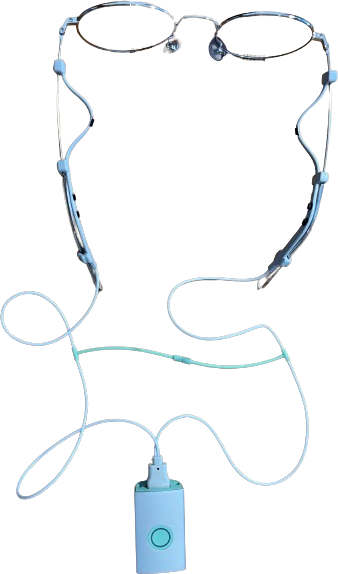
The Cephalgo EEG adapter fitted to a pair of eyeglasses, with its electronics unit on the cord

The adapter used in OPADE

Four dry-contact channels on an ordinary pair of glasses.

FT9T9FT10T10M1 ref.M2 ref.Front
Recording electrodes Reference
Channels
Four EEG channels
FT9, T9, FT10 and T10, referenced to M1 and M2
Acquisition
24-bit, 250 Hz
Dry-contact electrodes
Connection
Bluetooth LE
To the Cephalgo app on iOS or Android
Patent
US 11,980,470
EEG signal monitoring adapter device configurable on eyewear

Independently tested

Safety and compliance
Passed SGS safety, ingress and EMC testing.
IEC 62368-1 for electrical safety, IP64 for ingress protection, and EN 301 489-1 and -17, EN 55032 and EN 55035 for electromagnetic compatibility.
Signal validation
Against a widely used EEG system
An independent engineering laboratory recorded the adapter side by side with a widely used wet-electrode EEG system. It concluded that the adapter records scalp EEG with spectral structure comparable to the reference system.
Request the EEG validation report 
At rest, eyes closed
Equivalent to the reference

Relative band power was statistically equivalent to the reference system in every participant.

Blinking task
The expected peak on every channel

A clear spectral peak at the blinking frequency on every channel analysed, with a spectral shape similar to the reference system.

Both systems worn at the same time. Equivalence by paired two one-sided tests. From the independent laboratory report, April 2026.

From the temple to an analysable window

Every home recording is checked before it reaches analysis.

Step 1
Quality at ingest
Continuity, record eligibility and per-channel availability are checked. Spikes, flat runs and extreme spectral ratios are flagged.
Step 2
Clean windows
Analysis windows come from continuous portions only, filtered and resampled, with channel availability recorded for each window.
Step 3
Per-channel features
Relative delta, theta, alpha and beta power, spectral entropy and multiscale-entropy summaries.
Step 4
Compact decoders
Lightweight convolutional decoders for multivariate biosignals, sized for a wearable.

In a Horizon Europe study of major depressive disorder

The adapter is deployed in OPADE, at sites including Istanbul, Siena and Girona, with patients followed for 24 months. Cephalgo leads the EEG work in OPADE: the hardware, the participant app, and signal processing and quality control.

At home
A third of patients recorded fully at home
Short resting-state sessions on the adapter, with mood questionnaires completed in the same app.
What the recordings showed
EEG change alongside symptom change
Lower relative alpha and higher delta power accompanied symptom reduction, and moved back when symptoms rose again.

From the Cephalgo EEG report to the OPADE consortium, October 2026.

Licensing

Building EEG into a product or a study?

The adapter, the participant app and the signal pipeline are available for licensing.

Get in touch →

Cookie preferences

Choose which cookies this site may use. You can change this at any time from the footer.

NecessaryRemembers your cookie choice. Always on.
Always on
Advertising measurementGoogle Ads conversion measurement. Off unless you allow it.

Privacy policy

Request the EEG validation report

EEG validation report

We use your work email to send you the report and to follow up about it and related work. You can opt out at any time. Privacy policy

Thank you. The report will reach you by email.

Something went wrong. Please write to contact@cephalgo.com.

Thank you! Your submission has been received!
Oops! Something went wrong while submitting the form.